
These guidelines[1] are based on the assumption that the current state of the art and the possibilities offered by AI-based generative tools[2] are fundamentally changing existing practices in both study and research. Although the future course of development is unpredictable, it seems clear that AI is rapidly becoming an integral part of both the learning process and research practice. These guidelines aim to clearly define the legitimate and illegitimate use of generative AI tools at the Faculty of Arts, UPCE. This document will be updated on an ongoing basis to reflect the current state of affairs.
At the end of June 2026, Directive 2/2026 (Rules for the Use of Generative AI Tools in Studies) was issued, which codifies certain aspects of these recommendations. All students and faculty members should familiarize themselves thoroughly with the directive, even if they do not intend to use AI in their studies or teaching.
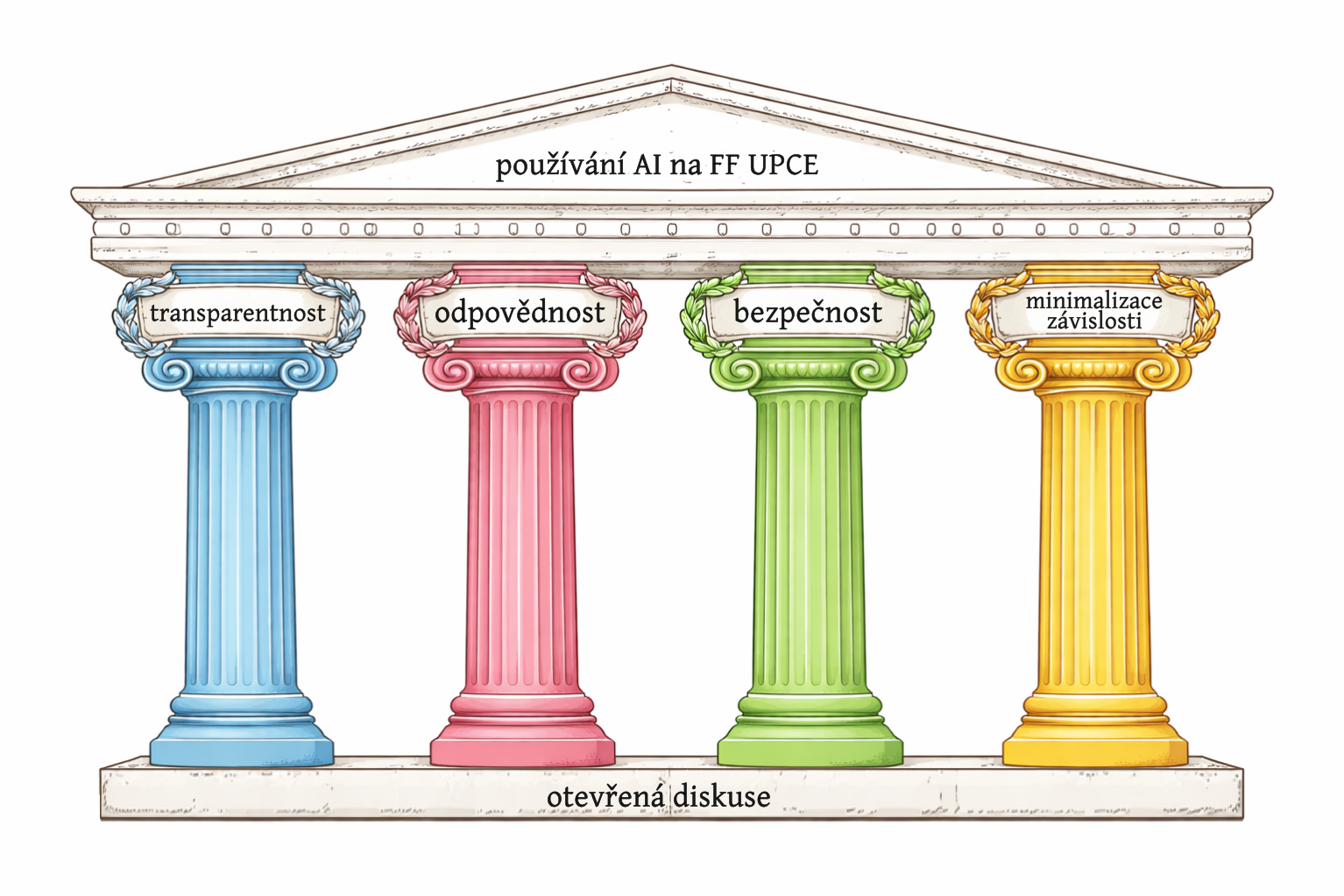
The use of AI at the Faculty of Arts, UPCE, is based on four pillars supported by open discussion [3]:
- Transparency (when I use AI tools, I acknowledge it and am open about it, just as I am when working with sources)
- Accountability (I bear the same responsibility for the outputs of AI tools that I present as I do for everything else; I work critically and conscientiously)
- Security (I use AI tools prudently; I am aware of the terms and conditions and what happens to the data I upload; I assess what I can and cannot upload)
- Minimizing Dependence (Using AI tools helps me and expands my possibilities, but I can function without them; they do not replace my brain)
Last update of the guidelines: June 24, 2026. Major changes from the previous version:
- Directive 2/2026 was issued
- The default level of AI use is now set to Level 3) General Use of AI
[1] AI tools were used at Level 3 to create these rules, in accordance with these guidelines.The English translation was created with DeepL AI tool on June 24, 2026, the translation was hand-checked, but if you notice any errors, please, let us know.
[2] The field of AI is very broad, but in this document we focus specifically on AI-based generative tools. Therefore, when we refer to AI, we are referring specifically to this area.
[3] We draw inspiration from the guidelines for AI use from Charles University [accessed Jan. 22, 2026]. The illustrative image was generated using ChatGPT (OpenAI, version 5.2 Thinking) [Jan. 22, 2026].
Directive No. 2/2026: Guidelines for Using Generative AI Tools in Academic Studies
| Files for download | Size |
|---|---|
| Smernice02_26 AIEN_136859.pdf - pdf | 260 kB |
For practical guidance, we use the following classification of AI tool usage at the Faculty of Arts, UPCE:
- No AI Use: At this level, any use of generative AI tools is prohibited. This also applies to basic functions that we often do not even consider to be AI, such as auto-correction in Word, the use of Grammarly[1] and similar tools, and the use of translation tools (e.g., DeepL, Google Translate).[2]
- Basic Use of AI: This level corresponds to common previous practice, i.e., the use of text-checking tools (Word), including advanced proofreading features offered by Grammarly, Writefull, and similar tools (more extensive stylistic editing using chatbots falls under Level 4). Edits made in this way do not need to be cited. When preparing outputs, it is also possible to use automatic translation tools (e.g., DeepL, Google Translate). If machine-translated passages are part of the output (typically, for example, quotations), they must also be cited as such. At this level, it is also permitted to use bibliographic research tools (e.g., within Elicit, SciSpace).
- General Use of AI: Generative AI tools may be used as a consultant, e.g., when creating the structure of a paper or exploring ideas. This level also includes the use of many academic AI tools (e.g., Elicit, JSTOR AI research tool), provided they do not directly interfere with the final text. However, beyond the possibilities outlined for Level 2, it is not permitted to use entire passages of generated text directly in the body of the paper; such passages must be explicitly cited as generated, similar to direct citations from other authors.[3]
- Advanced Use of AI: Beyond Level 3, it is possible to use generative AI tools as an active partner (“co-author”) in the creation of text. The text of the work is created through repeated, multiple interactions between the student and the AI: the student provides input, critically evaluates and selects from the offered options, returns the text for revision, adds their own phrasing, and adopts or modifies the AI’s phrasing. The student’s consistent creative participation throughout the entire process of text creation is essential. The mere one-time generation of text by an AI tool does not meet the criteria for this level. Such use must be declared and generally described (e.g., in the introduction) according to the nature of the paper.[4]
- Exclusive Use of AI: The student’s work is created using AI tools without any active contribution on the student’s part, without gradual and substantial improvements, or with only minimal intervention (e.g., with the help of an AI agent).
We were inspired to introduce these levels of AI use by a similar document from the Faculty of Arts at Charles University; available at https://uisk.ff.cuni.cz/cs/studium/pravidla-a-pokyny-pro-pouzivani-ai-studenty/ [accessed September 8, 2025].
[1] See https://knihovna.upce.cz/uk/grammarly [accessed September 8, 2025].
[2] Typically handwritten outputs, such as exams and the like.
[3] For example: “Generated by the Claude-AI Sonnet 4 model [September 11, 2025].” It may also be appropriate to include the prompt.
[4] For example: “Part of this text was created in collaboration with the ChatGPT tool (OpenAI, version 5 from September 2025). I originally wrote the text myself and subsequently had it edited and stylistically reworded using AI.”, or “While writing this paper, I used the generative tool ChatGPT (OpenAI, version 5-Thinking from September 2025) at level 4 according to the rules of the Faculty of Arts at UPCE. I used the AI primarily for stylistic and linguistic edits and to rephrase certain sections I had written myself. In a few cases, I also used the AI’s suggestions to supplement my arguments or to elaborate on ideas that I would not have formulated on my own. I then critically evaluated these suggestions and incorporated them into my own text. I, as the author, bear full responsibility for the content of this thesis.” These examples were generated using ChatGPT (OpenAI, version 5 from 9/2025) [September 11, 2025]. In some cases, the thesis may require a more extensive description of how the tools were used.
The general stance on the use of generative AI tools at the Faculty of Arts, UPCE, is open and transparent. It is governed by Guideline 2/2026 (Rules for the Use of Generative AI Tools in Academic Studies) [note: we will update the link when there is English translation of the directive]. The general rule is that what is not prohibited is permitted. However, students must transparently declare any significant use of AI tools (starting at Level 3 and above).[1]
Current AI tools make it possible to produce very high-quality outputs, but it is important to keep in mind that studying is not just about producing results. As part of their studies, students acquire many skills, competencies, and knowledge. The creation of interim outputs (seminar papers, presentations, etc.) is usually more of a means to this acquisition than an end in itself. In many cases, the use of AI tools may lead quickly and easily to the creation of a high-quality output, but the assigned task may fail to achieve the intended pedagogical effect. Therefore, we have established several levels of AI use, and instructors of individual courses may specify which level they require, or specify additional restrictions or options. Unless otherwise specified, Level 3) general use of AI applies.
These rules apply primarily to text-based outputs. However, analogous rules also apply to all other types of outputs, such as audiovisual outputs, quantitative data processing, programming, etc. It is always necessary to consider the appropriateness of such use. It is also always necessary to cite the source (the tool that generated the data, the date of generation, and, if applicable, the version of the tool used). It is advisable to consider adding a comment regarding other relevant context of the generation (prompt, reference to source data for graphs, etc.).
General Principles
Openness to the use of AI in no way undermines the principles of academic work and academic integrity. Whether you work with AI or not, you must adhere to the principles of ethics, transparency, responsibility, and security.
It is important to keep in mind that, according to current Czech legislation, AI cannot be considered an author. Students are therefore always fully responsible for the generated results.
Students are responsible for carefully verifying the information generated by the tool. If a student’s work requires citations, these must also be included for the generated text. Some tools provide links to the sources they drew upon. However, these sources may not always meet sufficient scholarly standards or may be misleading. If the nature of the referenced information requires it, students must locate relevant sources that support or comment on the information.
Unacknowledged or illegitimate use of AI in student work will be treated similarly to plagiarism and is subject to disciplinary proceedings.
Use of AI in Theses
As of January 2026, the use of AI in theses is also regulated at the university level. All information and recommendations can be found on the UPCE Library website. On the EDU portal, a course has been created on the use of AI in theses, which also includes a short overview video. [These resources are in Czech]
For bachelor’s and master’s theses, the level of AI use is determined by the thesis advisor based on the nature of the topics, theories, and methodologies. The use of AI at level 3 or higher must be explicitly commented on in the thesis, similar to how the use of sources is commented on. The level of AI use (and any further specifications) is explicitly stated in the thesis assignment; therefore, it is advisable to consult with the thesis advisor on this matter before accepting the assignment, even if the use of AI is not intended. In the case of Level 4 use, the thesis advisor bears increased responsibility for monitoring the progress of the thesis and the students’ independent contributions.
In the case of doctoral dissertations, we recommend using AI tools at a maximum of Level 3, particularly given the emphasis placed on the student’s own contribution and the position of the dissertation within the broader academic community, which includes scholars from other universities and abroad, where approaches to AI may differ significantly. We recommend consulting with thesis advisors regarding the use of AI. Here, too, the principle of explicitly and openly commenting on all uses applies. The rules for the use of AI in the writing of doctoral dissertations are set forth in Article 8, Section 3 of Directive No. 2/2024, as amended by Addendum No. 2/2025, “Doctoral Programme Rules at the Faculty of Arts and Philosophy.”
AI Education at the Faculty of Arts, UPCE
Within the framework of these rules, the Faculty of Arts, UPCE, also commits to ensuring that AI-related issues, including the use of generative tools, are systematically addressed in the courses it offers. Currently, for example, the Faculty of Arts offers the course Selected Issues in Artificial Intelligence, available as an elective [but taught in Czech]. It is also recommended to incorporate work with AI tools into introductory courses within the respective degree programs. The offer of dedicated courses in English is at this point, unfortunatley, non-existant.
Not sure?
If you’re unsure about what to do or how to proceed, consult your instructor or email frantisek.valek@upce.cz or jiri.unger@upce.cz.
[1] For example, comment on the use of AI in the introduction to your paper, or cite specific instances of its use. Specific citations must follow the appropriate citation style; see, for example, https://www.chicagomanualofstyle.org/qanda/data/faq/topics/Documentation/faq0422.html [accessed Sept. 11, 2025].
Teaching
At the Faculty of Arts (FF) of UPCE, we take a flexible approach to the use of AI tools in teaching. In general, the principles of academic work and academic integrity apply here as well. Instructors are fully responsible for the preparation and quality of course materials.
Instructors are always fully responsible for awarding grades and assessing student performance. The use of AI tools up to Level 4 is permissible in the evaluation process. If AI tools (Level 3 and above) are used to assess student activities or provide feedback, instructors must communicate this fact transparently and in advance. Assessment must never be based solely on AI tools.
Publication Activity
The use of generative AI tools in research cannot be specified across the board. The principles of academic work and academic integrity—particularly the emphasis on publication ethics, transparency in the process of creating academic texts, secure data handling, and overall responsibility for the final output—are absolutely crucial here. [1]
If rules for the use of AI in the publication process are specified, for example, by a publisher, authors must adhere to these rules.
When preparing peer reviews, particular attention must be paid to the principles of academic integrity, which does not necessarily preclude the use of AI (unless otherwise specified by the publisher).
Training for FF UPCE Faculty Members in AI
FF UPCE is committed to providing ongoing training in the use of AI tools for research and teaching purposes.
AI and Data Security
The active use of AI raises data security concerns. If there is a need to share sensitive data using these tools, it must be done in a secure environment (some tools offer optional data protection; such protection may be included in subscriptions, or systems running within the university may become available in the future).
[1] For a cautionary example of bad practice, see, for example: https://scienceintegritydigest.com/2024/02/15/the-rat-with-the-big-balls-and-enormous-penis-how-frontiers-published-a-paper-with-botched-ai-generated-images/ [accessed September 8, 2025].
Do you have any questions?